Trend Watch · Spring 2027 · Footwear
Snake heels, a jewel at the vamp, snakeskin, and gold cap-toes: the four footwear trends of spring 2027
On 29 September 2026 Saint Laurent showed its spring 2027 womenswear collection at the Trocadéro in Paris — 49 of the 59 looks came out in gold. Ten days later the house confirmed Anthony Vaccarello was ending his ten-year tenure, which turned the show into his farewell. The gold shoes "slithered" down the runway and became the talk of Paris Fashion Week. WWD's footwear review broke the season down into four trends; we follow the same order.
This is a trend observation. It implies no partnership, licence or sub-contracting relationship with any brand mentioned. Runway images are press material; rights remain with their owners and they are used here for trend reporting only.
Why this season is worth reading
Two news waves: the show, then the exit
Wave 1 · 29 Sep 2026, the show
The shoes were covered on their own
WWD's footwear desk called the collection's shoes the talk of Paris Fashion Week and ran three footwear pieces within three days: a trend review, a 17-image close-up gallery, and a front-row shoes gallery.
Wave 2 · 9 Oct 2026, the exit
A ten-year tenure closes
Weeks of departure rumours were confirmed on 9 October. WWD, Vogue, W Magazine, Harper's Bazaar, Wallpaper, The Cut and the NYT all followed, stretching the conversation another two weeks.
The shoes themselves were designed by Vaccarello with the house's freelance design director of men's and women's shoes, Corrado De Biase, who carried the collection's gold theme all the way down to the feet. The show supplied plenty of material of its own: 59 looks, the first 49 in gold, the last 10 in black; three giant gold candelabra-style chandeliers over a black runway. Chinese-language outlets — Toodaylab, ELLE China, Forbes China, Sina, FashionNetwork.cn — published within days of 1 October.
To gauge the scale yourself, three public indicators are worth checking: whether Google Trends forms a double peak on 29 Sep and 9 Oct, the volume on Weibo's trending list, and where the season places on Vogue Runway's most-viewed list. We don't quote view-count figures that have no verifiable source.
Trend 1 · The strongest angle
Sculptural snake heels: the standouts of the season all stood on a snake
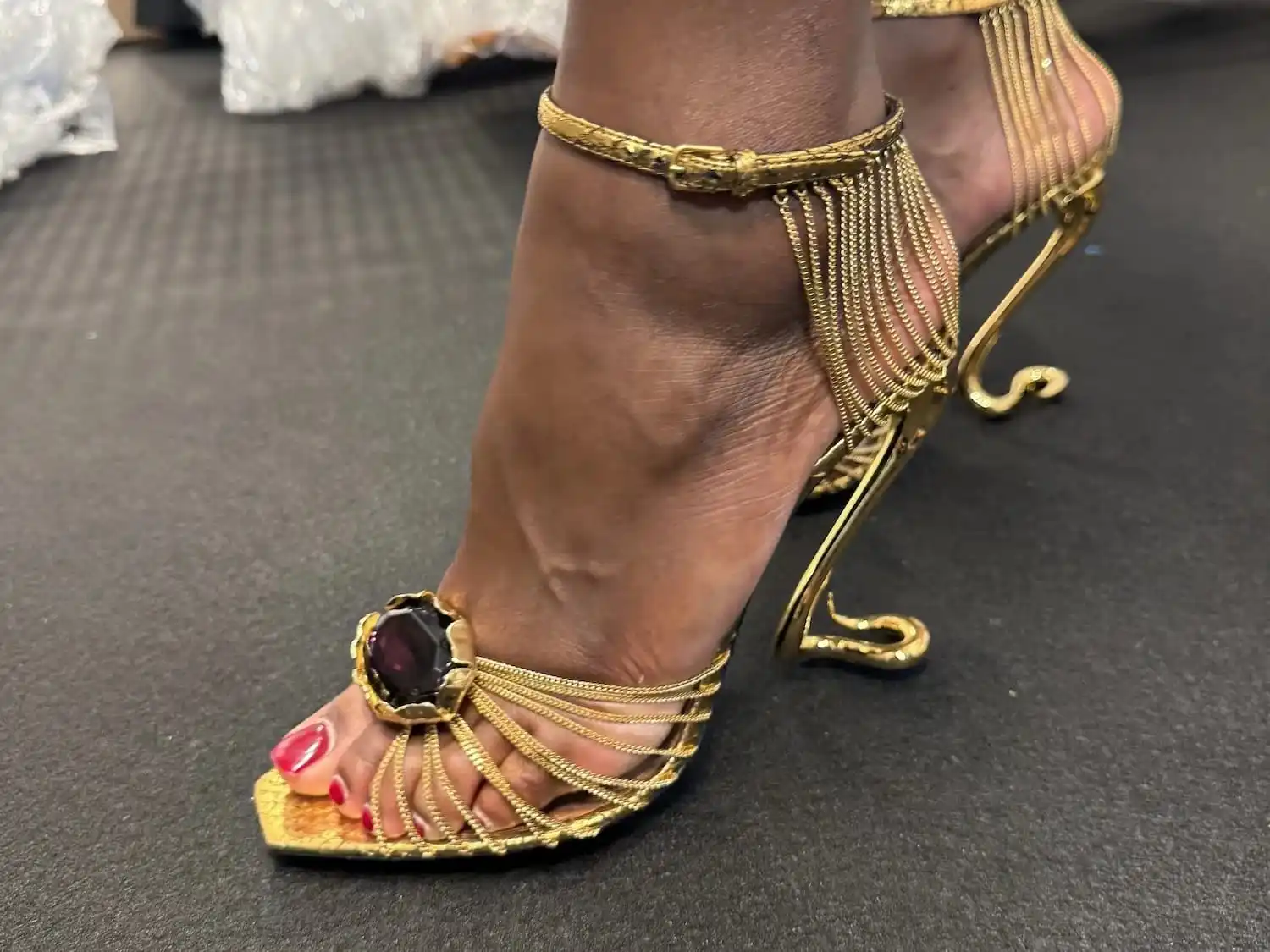
In WWD's words, the most striking styles of the lineup stood on curvaceous, sculptural heels resembling slithering snakes. In the same show, gilded metallic chains appeared across several sandals, creating "a sense of delicate and dynamic glamour" — on some styles the chains reached across the toes and met a large, opulent jewel at the centre of the vamp.


It is the strongest angle of the season because it cannot be followed by changing a colour — the whole heel body has to be re-moulded. And that is exactly the part a footwear factory has to be able to answer.
Trend 2 · Gilded chains and the jewel at the vamp
Chains across the toes, meeting a single jewel at the centre of the vamp
WWD's second element is gilded metallic chains, used across several sandals to build that "delicate and dynamic glamour". The most recognisable version: the chains reach across the toes, fan out over the foot and meet a large, opulent jewel at the centre of the vamp. The gold here is not a block of colour — it is a set of lines.

Trend 3 · Snakeskin and reptilian embossing
The snake continues onto the upper: beige, blue, and a quiet reptilian emboss on the toe
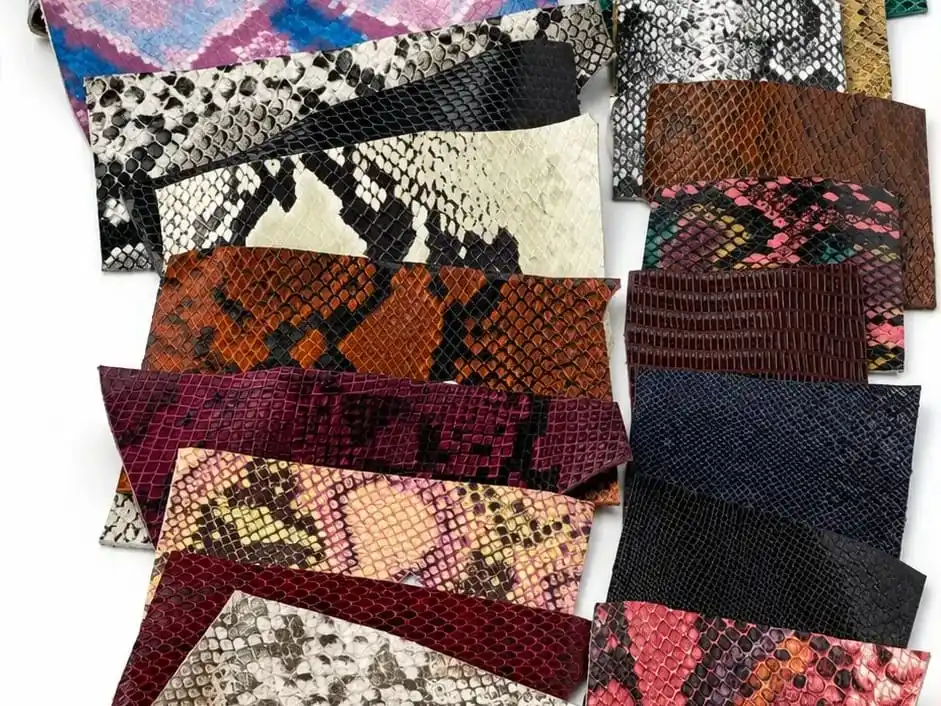
WWD notes that some sandals featured snakeskin in colours like neutral beige or blue; other chain-covered sandals carried a subtle gold reptilian embossing across the toe. Within one season the snake sits both on the heel and on the upper — the first is a structural problem, the second is a leather problem.
Trend 4 · Gold cap-toe slingbacks
Gold moved to the toe: cap-toe slingbacks in satin, sharp toes and square-cut vamps
The fourth trend is the gold cap-toe: a lineup of slingback pumps with a prominent metal cap on the toe, keeping two house signatures — elongated sharp toes and square-cut vamps. The bodies were satin, in shades running from jewel tones through to neutrals.

What matters more than any single pair is how they were shown: the same pump fanned out in red, burgundy, dark green, brown, purple and black — one silhouette taken all the way across the colour card. It echoes the collection's own logic: the house explained that gold let the designer explore "the power of repetition", the way he has previously explored silhouette — deep gold, Byzantine gold, pale gold, Renaissance gold, matte gold, Art Deco gold, burnished gold. On a runway it signals a shape the brand intends to push as a core style; commercially, it means reorders.

Yves Saint Laurent on the colour: "I love gold, it's a magical color. When reflecting a woman, it's the color of the sun." This season, that sentence was built into the shoes.
How it lands in a factory
Four trends, three questions on our side
Case one · the snake heel
From a stack of python-print leather to a snake wrapped around the heel
A snake motif splits into two independent jobs on the factory floor: the material side — scale direction has to be checked against the design drawing at the leather-picking stage so both shoes of a pair match, and reorders have to match the original colour reference; and the structure side — a metal snake coiled around the heel post is, in engineering terms, a load-sharing problem between the heel seat, the steel shank and the decorative component.

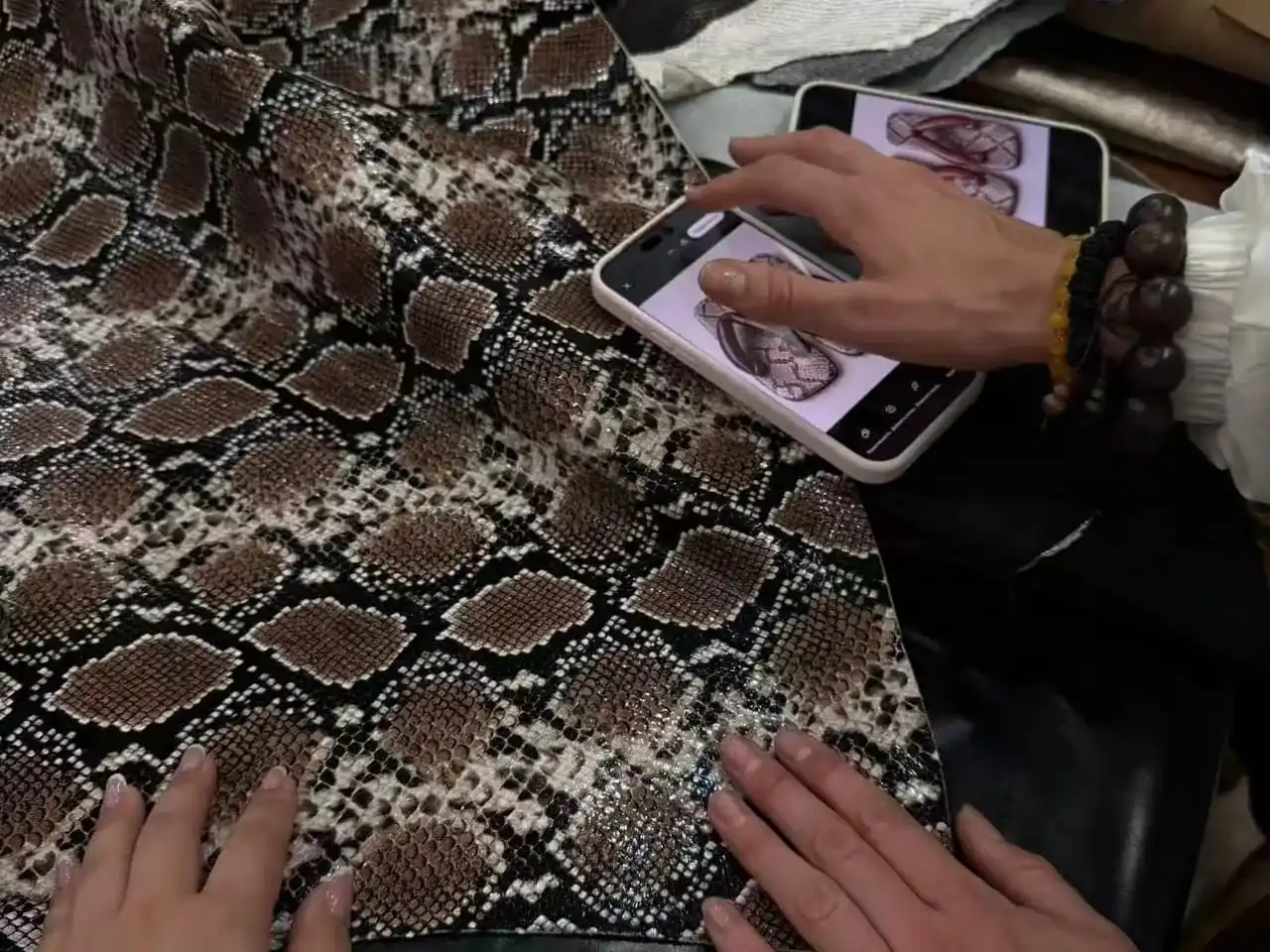
Three hard constraints: ① a snake or sculptural heel has no off-the-shelf equivalent — it starts from a drawing and a mould; ② the anchor points of the decorative component must avoid the joint between heel seat and steel shank — 1 mm out and the heel wobbles, then works loose after a few wears; ③ a thin heel post of φ8–12 mm cannot take a thick leather wrap — it can only be sprayed, coated or covered in thin PU, so if you want a leather-wrapped handfeel the post has to be thickened at the drawing stage.
Once the runway is broken down, three questions are left: can the heel be moulded, which surface treatment does it take, and how is the forepart built. We run development in three stages and freeze the specification at the end of each one before moving on — the only purpose being that bulk production doesn't drift from the sample. For a sculptural or snake heel, tell us the use case as well (show piece or everyday wear); it decides the surface process.
Stage 1
Last and heel
Heel height, heel shape, and the fit between steel shank and heel seat. Sculptural and unusual heels are moulded here.
Stage 2
Surface and materials
Spray, vacuum metallising, electroplating, leather or satin wrap — plus upper colour reference and scale direction.
Stage 3
Structure and comfort
Toe allowance, cap angle, forefoot room and heel-cup grip — validated by wear before the pattern is graded.

Send us a drawing or a reference shoe and we answer with four things: whether the heel can be moulded, which surface treatment it should take, how the steel shank and heel seat should be matched, and what the sampling milestones look like. MOQ is 100 pairs per style per heel height.